Quarter Wave Retarder

- 1/4 Wave in Medium & High Temperature Versions
- High Clarity
- Uniform Birefringence
- Polymer Based Cellulose Diacetate (CDA)
- Can be Laminated Between Glass or Acrylic for Increased Durabilty
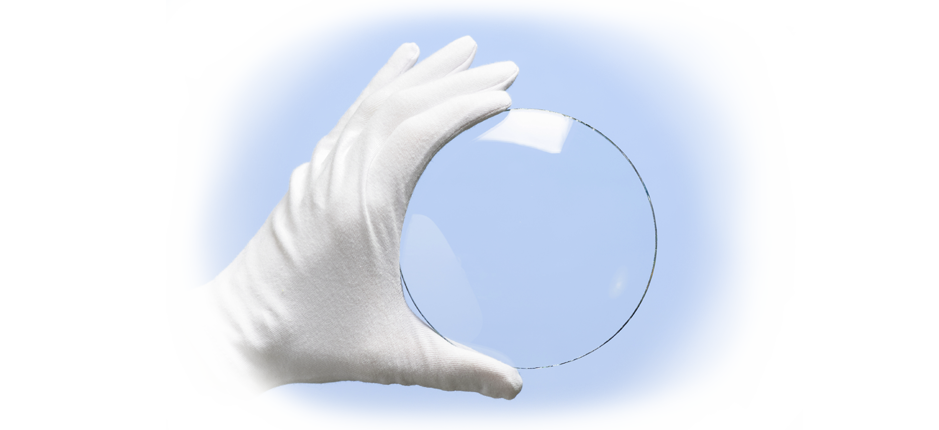
API’s quarter wave retarders are chromatic single layer polymer films offering great performance and clarity. Our wave retarders are optimized at 560nm (140nm OPD) More cost effective than traditional wave plates, our wave retarders feature uniform birefringence, low haze, good dimensional stability, and excellent optical quality
API offers two versions of quarter wave retarder: medium temperature (65ºC) and high temperature, low haze (80ºC). Both are diacetate (CDA) based with protective masking on both sides.
API can laminate our quarter wave retarder films to both acrylic and glass for added durability and improved optics.
How does a quarter wave retarder work?:
Wave retarders are birefringent materials that alter (retard) the polarization state or phase of light traveling through them. A wave retarder has a fast (extraordinary) and slow (ordinary) axis.
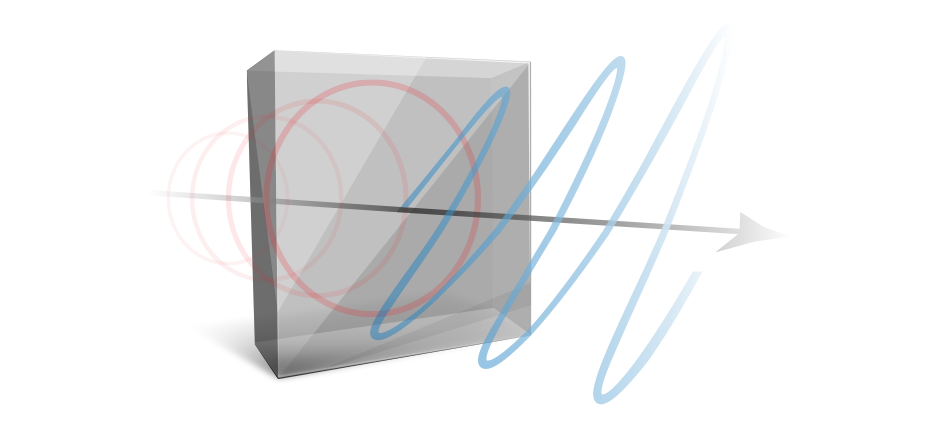
As polarized light passes through a wave retarder, the light passing through the fast axis travels more quickly through the wave retarder than through the slow axis. In the case of a quarter wave retarder, the wave plate retards the velocity of one of the polarization components (x or y) one quarter of a wave out of phase from the other polarization component.
Polarized light passing through a quarter wave retarder thus becomes circularly polarized (see Figure 1). The action of the quarter wave is sometimes referred to as twisting or rotating the polarized light. Note that depending on which polarization component is retarded, one will have either a left handed or right handed circular polarizer.

One the other hand, a half wave plate (two quarter wave plates combined) will not create circularly polarized light, but, instead, rotate the input polarized light 90º
Retardation films can be referenced in two ways: the Optical Path Difference (OPD) or the Center Wavelength. For example, if one references a wave retarder by the OPD, you would say “1/4 wave at 140nm”. That same wave retarder can also be referenced as “1/4 wave centered at 560nm.”